Showing posts with label Sanskrit. Show all posts

Sunday, January 8, 2017

Kelly Shares Some Meaningful Tattoos

Last June I met Kelly across from Federal Hall on Wall Street.

She was visiting from Ohio, and shared several of her tattoos.

First up is this koi:


Kelly explains:
"My older brother took me for my first tattoo when I was eighteen and got this whole party started.  He passed away three years ago and he had this tattooed on his calf, and I knew that I was gonna get one of his tattoos tattooed on me ... koi in Japanese is a homophone, so depending on what context it's used in, the meaning is understood, so it means the fish, obviously, but it also means love and affection, so that's how I chose the one that he had, that's how I picked it."
She also has these lovely flowers on her inner forearms:


Kelly elaborates:
"The writing here I had on both arms first and this [pictured on the right], in Sanskrit, means pratijna, it means a promise or a vow ... it's my promise to do my work in life. And this one [pictured on the left] on my right arm with the purple flowers, it's dharma, which is the principle that, if everyone does their life's work, the universe will come into working order.
And then the two different flowers I have, they're both just different types of flowers, but both named for Joan of Arc."
Lastly, Kelly shared this piece:


She explained that "this one is my feminist fist of revolution with kundalini the snake from Hindu mythology integrating herself in my feminist fist."

She credited all her work to artist Mike Hutton (@mikehutton) from Tattoo Faction (@tattoofaction) in North Olmstead, Ohio.

Thanks to Kelly for sharing her cool tattoos with us here on Tattoosday!

This entry is ©2017 Tattoosday.

If you are seeing this on another website other than Tattoosday, without attribution, please note that it has been copied without the author's permission and is in violation of copyright laws. Please feel free to visit http://tattoosday.blogspot.com and read our original content. Please let me know if you saw this elsewhere so I contact the webmaster of the offending site and advise them of this violation in their Terms of Use Agreement.

Friday, April 4, 2014

The Tattooed Poets Project: Teresa Mei Chuc's Cross-Cultural Ink

Our next tattooed poet is Teresa Mei Chuc, who has had all of her tattoos done at Shogun Tattoo in Pasadena, California by Andrew Moore.


Teresa tells us:

"My first tattoo, in Tibetan script, is my dharma name, Rinchen Khandro, which means 'precious dakini or sky dancer' in Tibetan. The name was given to me by Wangchen Rinpoche of the Maha Vajra Center in Los Angeles during my Buddhist refuge ceremony. The name means a lot to me because it embodies my spirit and purpose in life...dancing in the sky has a deep metaphorical meaning to me. The sky also represents sunyata. I wanted it tattooed because I wanted to always remember it among all my other names (Vietnamese - Tue, Cantonese - Mei Wai, American - Teresa).
The other tattoo on my back is cherry blossoms. I found out recently through a mitochondrial DNA test that I was part Japanese and the cherry blossoms represent that part of myself. I had known that I was part Vietnamese and part Chinese; my Japanese lineage came as a surprise and I wanted to embrace that part of me and the history that is interwoven with it."
"The tattoo on my wrist is the word 'sunyata' in Sanskrit. Sunyata means emptiness, nothingness, openness. It is an important concept to me and a very important concept in Buddhism."

"The tattoo on my upper arm is a Vegvisir, a Norse protection symbol. It is a Runic compass and a symbol from the 17th century Icelandic grimoire called Galdrabok ('magic book'). I tend to get lost, so I hope this built-in compass will keep me from getting lost."

"On my leg is an endless or eternal knot, an important Buddhist symbol representing the interweaving of the spiritual path, the flowing of time and movement within that which is eternal.
I find these days, it is easier and easier to forget the important things and my tattoos help me to remember."
Teresa also sent along her poem "Pencil," which was previously published in the anthology Mo (Silkworms Ink, 2011) and in The Good Men Project:

Pencil

"In spite of everything I shall rise again:
I will take up my pencil, which I have
forsaken in my great discouragement,
and I will go on with my drawing."


- Vincent Van Gogh


A missile is shaped like a pencil -
its long, slender body and pointed
end creates history.

A girl walking down the street
a few steps ahead of her sister and friend,
two medics who were trying to help
injured people, the parked ambulance -
all were annihilated by the same weapon.

Above, drones - silent, unmanned planes.
A metal, predatory bird that shoots a missile
with precision, identifying the colors of a shirt,
the features on a face - the shape of a nose,
the color and length of a mustache.

In a room far away, in another country, a man
sits at a desk and looks at a screen; he strokes
his thick, dark mustache as he carefully
contemplates, then pushes a button.

There is a charred hole in the ground
where the girl once stood.

There are pencils that write and erase,
write and erase, so that there is nothing
to be read on the page. The page blank
as the desert sky, blank as the smooth shell of a drone.

There is a family drinking mint tea
in a living room.
The man holds a cup to his lips,
the glass touches his mustache.
A silent bird hovers above.
In a split second, everyone is dead,
the house is in rubbles - arms, legs,
splattered organs among broken concrete.

Soon, there will be no trace.

~ ~ ~

Teresa Mei Chuc was born in Saigon, Vietnam and immigrated to the U.S. under political asylum with her mother and brother shortly after the Vietnam War. Her poetry appears in journals such as EarthSpeak Magazine, Hypothetical Review, Hawai’i Pacific Review, Kyoto Journal, The Prose-Poem Project, The National Poetry Review, Rattle, Verse Daily and in anthologies such as New Poets of the American West (Many Voices Press, 2010), With Our Eyes Open: Poems of the New American Century (West End Press, 2014), and Mo’ Joe (Beatlick Press, 2014). Red Thread is her first full-length collection of poetry. Her second collection of poetry was just accepted for publication by FootHills Publishing and is forthcoming in 2014! Visit her at www.tue-wai.com.

Thanks to Teresa for contributing to the Tattooed Poets Project on Tattoosday!

This entry is ©2014 Tattoosday. The poem and tattoo are reprinted with the poet's permission.


If you are reading this on another web site other than Tattoosday, without attribution, please note that it has been copied without the author's permission and is in violation of copyright laws. Please feel free to visit http://tattoosday.blogspot.com and read our original content. Please let me know if you saw this elsewhere so I contact the webmaster of the offending site and advise them of this violation in their Terms of Use Agreement.

Tuesday, January 7, 2014

Amita's Lovely Sanskrit Tattoo

Last spring (yes, as in spring 2013), I attended a talk at NYU where one of my old schoolboy chums was speaking.

One of the event hosts, named Amita, had a lovely Sanskrit tattoo on her arm, and she allowed me to take a photo.


Alas, my e-mails to her have gone unanswered, so I’ll just post this and move on.

Thanks to Amita for sharing with us here on Tattoosday!

This entry is ©2014 Tattoosday.

If you are seeing this on another website other than Tattoosday, without attribution, please note that it has been copied without the author's permission and is in violation of copyright laws. Please feel free to visit http://tattoosday.blogspot.com and read our original content. Please let me know if you saw this elsewhere so I contact the webmaster of the offending site and advise them of this violation in their Terms of Use Agreement.

Monday, April 22, 2013

The Tattooed Poets Project: Kazim Ali

Our next tattooed poet is Kazim Ali.

When I reached out to Kazim at the beginning of the year, he commended me on the "prescience" of my inquiry, stating "I am as yet unwritten upon but am planning said writing in the next week or two...".

So, when Kazim sent us this photo, the ink was still fresh:


It's a great shot and when I first saw it, I was interested to hear what these lines of text were all about. Kazim didn't disappoint with this history:
"I have practiced yoga since 1999, never feeling more than a strict beginning, knowing less and less about yoga with every passing year. With poetry it feels the same. Though raised with traditional Muslim values, I struck out on my own to try to figure out God after encountering the work of Fanny Howe. From 2009-2011 I worked on my own book about yoga and Islam, called Fasting for Ramadan. While working on that book I came across and began translating the work of 20th century Iranian poet Sohrab Sepehri. One of his lines that resonates for me the most talked about the qibla, the direction of Muslim prayer--the direction toward which one must turn to face Mecca.

Sepehri's line (in translation) is roughly: I am a Muslim. My qibla is toward one single bloom of a rose.
Needless to say, my yoga practice taught me to always strive, to always try to know, that living (with or without a spiritual practice) is that exactly, a 'practice,' meaning 'process.' To write on the body is not permanent at all because the body is not permanent. To inscribe is to strive. The Farsi script runs right to left and the Sanksrit runs left to right. Each attempt at knowing oneself starts in the world, with others, in community, something I learn from both Islam and from Yoga.
I wrote on my left forearm: Man musulmanam. Qiblam yek ghul-surg.
I wrote on my right forearm the first line of the Yoga Sutras: Atha Yoganusanam. [in translation: Now (here, at this very moment in this very place) begin the teaching of yoga.]"
Kazim described how he came to know his tattoo artist:
"I met Sam McWilliams through my friend, Genine, also a poet. I wanted someone to write these sacred scriptures onto my skin and I wanted someone who would understand, if not the power of the scripture itself, then for sure the sacred quality of writing and of bodies. Sam had lived with Genine for a long while at the San Francisco Zen Center.

I went to Mermaids Tattoo, a special place where all the tattoo artists are women. We talked about the scripts and Sam said that while she had written Sanskrit before she had never written Farsi. I liked the idea of being in the hands of someone who knew her scripts but would be writing one for the first time. It felt like an occasion in the universe."
Kazim sent us this poem, which is an excerpt from a longer poem, which appeared in his book SKY WARD (Wesleyan University Press, 2013)

from "Journey to Providence"

but will I broken will I undone
at the water ask to go deeper a boat
dusting lindern clears away envy

wandering like lilac snow in dunes
never the water enter the duskwarm room
will I let you wing me will I have leapt skyward

~ ~ ~

Kazim Ali is the author of four books, most recently SKY WARD. He has also published two novels Quinn’s Passage and The Disappearance of Seth, two collections of essays, Orange Alert: Essays on Poetry, Art and the Architecture of Silence and Fasting for Ramadan: Notes from a Spiritual Practice, and translations of Sohrab Sepehri, Marguerite Duras and Ananda Devi.

His poems and essays have appeared widely in such journals as American Poetry Review, Kenyon Review, Hayden’s Ferry Review, Colorado Review, Denver Quarterly and the Harvard Divinity Bulletin. He edited the essay collection Jean Valentine: This-World Company and serves as co-editor of the Poets on Poetry Series and the Under Dicussion Series, both from the University of Michigan Press, contributing editor of AWP Writers Chronicle, associate editor of Field, and founding editor of Nightboat Books.

He is an associate professor of Creative Writing and Comparative Literature at Oberlin College and has served as visiting writer at many colleges and universities including Naropa University, St. Mary’s College of California, New England College, Texas State University, Western Illinois University, University of Michigan, University of Wyoming, the University of Southern Maine and Idyllwild Academy.

Thanks to Kazim Ali, not only for sharing his tattoos and poetry on the Tattooed Poets Project, but for taking the time to expound so thoughtfully on how he came to have this work done.


This entry is ©2013 Tattoosday. The poem and tattoos are reprinted with the poet's permission.


If you are reading this on another web site other than Tattoosday, without attribution, please note that it has been copied without the author's permission and is in violation of copyright laws. Please feel free to visit http://tattoosday.blogspot.com and read our original content. Please let me know if you saw this elsewhere so I contact the webmaster of the offending site and advise them of this violation in their Terms of Use Agreement.

Wednesday, March 10, 2010

Amy's Circle of Sanskrit Honors The Loss of Something She Needed to Lose

It was one of those New York City Tattoosday moments, when you really hit it off with someone and a simple question about a tattoo turns into a lengthy conversation.

I was coming home much later than usual and, at West 4th Street, where I'll occasionally switch from the A train to the D train, I spotted a woman in front of a subway map on the platform. She had tattoos on her ankles and was carrying a large hoop.

Amy, a nursing student and trapeze artist, shared the long segments on either side of her right food, inked in Sanskrit, quoting the Baghavad Gita:


She paraphrased the meaning as "Weapons do not pierce this. Fire does not burn this. Such is the eternal nature of the soul."

Or, in one translation, referring to the Atma, or higher self:

Weapons do not cut this Atma, fire does not burn it, water does not make it wet, and the wind does not make it dry. (2.23)
This Atma cannot be cut, burned, wetted, or dried up. It is eternal, all pervading, unchanging, immovable, and primeval. (2.24)

Why this quote? Aside from her appreciation of Hindu art and design, she got in "in honor of forgetting a person's number that I really needed to forget".

In other words, as I interpret it, she couldn't remember the number of someone who she was better off without. Her mind released the link to the person the heart craved and, in hindsight, the mind was operating in the best interest of the soul.

She had this work done by an artist at Purple Panther Tattoos on Sunset Boulevard in Hollywood California.

Although the photos above were taken on the train platform at West 4th, we spent a good amount of time chatting on the D train after it pulled into the station. We talked about tattoos mostly, and I recommended some artists to check out in New York.

Amy said she had been recently thinking about a new tattoo and it was funny that I just happened to approach her about her own work.

We parted ways when the D rolled into 36th Street in Brooklyn, where I switched to the R train, and Amy headed to work teaching an Aerial Hoop class (which explains her possession of the large ringed object I alluded to at the beginning of the post).

A hearty thank you to Amy for sharing her inspirational tattoo with us here at Tattoosday!

Saturday, November 21, 2009

Shom's Chakra

I met Shom very briefly as he was about to board a train at Penn Station.

Aside from shoulder pieces and Sanskrit text circling his upper left arm, he has a couple of other tattoos, including this one on his inner left forearm:


This piece represents one of the many chakra for meditation.

It was inked at Jinx Proof Tattoo in Washington, D.C. Work from that shop has appeared previously here.

Shom had to board his train before I could get more information, but I express sincere thanks for his brief participation here on Tattoosday!

Monday, June 23, 2008

Peter Caruso's Ink: Old-School Brooklyn Represented

These two inner-arm pin-ups belong to local free-lance tattoo artist Peter Caruso.

I ran into Peter a couple of Sundays ago, caught without my camera at the local 7-Eleven, so I left him with a flier so he could check out Tattoosday . He did, and e-mailed me shortly thereafter, offering to meet up, take pictures, and talk tattooing. This past Sunday, we reconnected in front of the 7-Eleven and I took a few shots of his awesome tattoos.

Here's Peter with his forearms extended:

Your standard article on the popularity of tattooing in 2008 always looks back to the old days, back when the only inked folks around (supposedly) were bikers, veterans or sailors, criminals and circus performers.

But we are living in an "enlightened" era, says the conventional wisdom, when there is a lot less stigma attached to the art. Tattooing was illegal in New York City from the early 1960's to the mid-1990's.

Peter remembers growing up in Bensonhurst and admiring the tattoos of the neighborhood heavies. There was a lot of admiration for the tattooed gangster-types that were the fixtures in the neighborhood delis, hanging out in front of the mom-and-pop stores, and being active in the community.

Peter admired the ink, and that old school style has influenced not only his own work, but the work he had done on himself.

Peter learned from, and was influenced by, those artists he considers to be the "Old School" of Brooklyn tattooists.

He worked with and apprenticed under Paul Raffelo of Paulie Tattoo and Vito of Vito Tattoo.

He estimates that he has approximately 13 tattoos, including 2 full sleeves.

A closer look at the pin-ups on his forearms shows a style of tattoo that is classic old-school. Peter said that this was the type of tattoo that was typical in the old neighborhood he grew up in.


The "Steady as She Goes" motto was a standard phrase in a lot of old naval flash art.

These pinups were inked by Paulie Tattoos.

On Peter's inner right forearm is a green Tibetan ritual mask:

The mask is used, according to tradition, to drink the blood from the head in an attempt to keep the spirit alive after the body dies. Vito of Vito tattoos was the artist.

Peter is also particularly proud of this Sanskrit piece on his forearm:

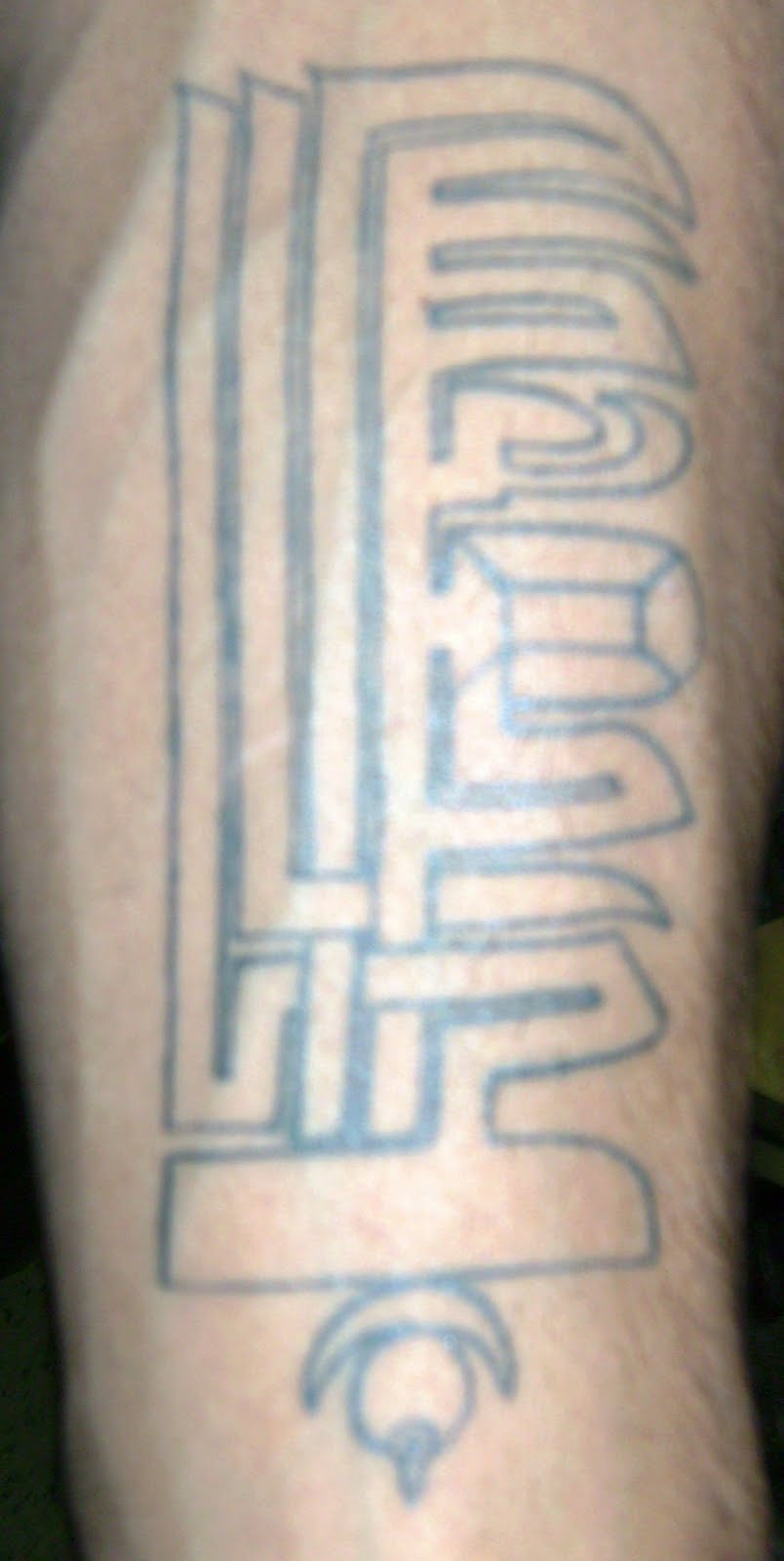
Peter explained that this represents the thunderbolt that destroys ignorance, a concept explained by the term vajra and a precept in Buddhism that leads to the destruction of ignorance through enlightenment.

Thanks to Peter Caruso for sharing his tattoos here on Tattoosday. Peter is currently working free-lance and can be contacted by clicking here.

Monday, March 17, 2008

Tattoos I Know: Paul Part 2, or, The Traditional Japanese Sleeve

NOTE: This post was updated on March 31, 2008 with three additional photographs.

Here's a Tattoosday first: a repeat subject in this blog's history.

Paul appeared here first, showing off his first tattoo, a dragon. In this post, Paul returns, showing off a full sleeve on his left arm.

The sleeve consists of traditional elements: there is a dragon, a lotus, a mask, a lily, and a koi.

If you went back in a time machine 8 or 9 years to visit Paul's arm, you would have seen a grim reaper holding a skull on the bicep:


and some roses in a pattern on the forearm. These earlie
r tattoos have been covered by elements in the sleeve. Even when told where the original ink lies, it's extremely difficult to see the previous work.

So I will break this down into two sections: the upper arm and the lower arm.

The upper arm began with the dragon cover-up:


The dark rock below the dragon covered the old piece. This design, which included the aum or om symbol at the top of the arm, was inked by Carlos at Rising Dragon Tattoos in Chelsea back in 2001. The aum symbol is the Siddhaṃ script version and is a mystical and sacred symbol in Indian religions. Note that this om is different than the one that appeare din the first Tattoosday post here.

Paul was not 100% thrilled with the dragon, so when he decided to finish the sleeve, the following year, he went elsewhere.

The lower part of the arm, which is the more prominent part of the sleeve, was inked by Mike Bellamy at Red Rocket Tattoo in Manhattan, although at the time his shop was known as Triple X Tattoo.

The specific elements in the sleeve are all traditional irezumi, or Japanese tattooing, elements.

The largest piece is the koi. It appears to be a golden koi.

There's a whole discussion here on what koi tattoos symbolize.


In addition, one can read here about the symbolic nature of the lotus flower in tattoos.


Paul also
referred to the other flower as a spider lily.

However, there are so many different varieties of specific families of flowers, that I often have a hard time finding good pictures to represent the tattoos.

The additional element in the sleeve which is only a small part, but is still interesting is what Paul referred to as the "kite mask":

Masks are traditional parts of Japanese tattoo design, but this specific one is hard to pinpoint for me. Here are some Chinese mask kites. Yet, the fact that I cannot easily find one on the web, just fascinates me more.

Paul estimates that the whole sleeve (including the dragon from 2001) took about 20 hours of work, and he did it in 6-7 sittings, mostly in 2002.

Paul sent me the following photos from the New York City Tattoo Convention, where Mike Bellamy did some of the work on Paul's sleeve:

That's Paul and Mike on the far left of the photo:

Thanks to Paul for helping me update this post with additional shots!